
The ACT Teacher Quality Institute (TQI) is the independent statutory authority responsible for registering, regulating and elevating the teaching profession. Our regulatory role ensures every child and young person in the ACT learns in a safe environment supported by qualified, suitable and professional teachers.
The TQI Regulatory Framework
The ACT Teacher Quality Institute’s (TQI) regulatory framework explains how we support quality teaching and keep children safe in ACT schools and early childhood settings. It sets out how we register teachers, work with employers, manage risk and respond when concerns arise.
At its core, the framework helps us make fair, consistent and proportionate decisions, while keeping regulation as simple and practical as possible. Click here to download the TQI Regulatory Framework.
Why the regulatory framework exists
Our role is to register, regulate and elevate the teaching profession in the ACT. The framework helps us do this by:
- making sure only suitable, qualified teachers work with children
- protecting children’s safety and wellbeing
- supporting public trust in the teaching profession
- helping teachers and employers understand their responsibilities
- reducing unnecessary regulatory burden, so teachers can focus on teaching.
The framework is grounded in the ACT Teacher Quality Institute Act 2010 and the Australian Professional Standards for Teachers.
Our approach to regulation
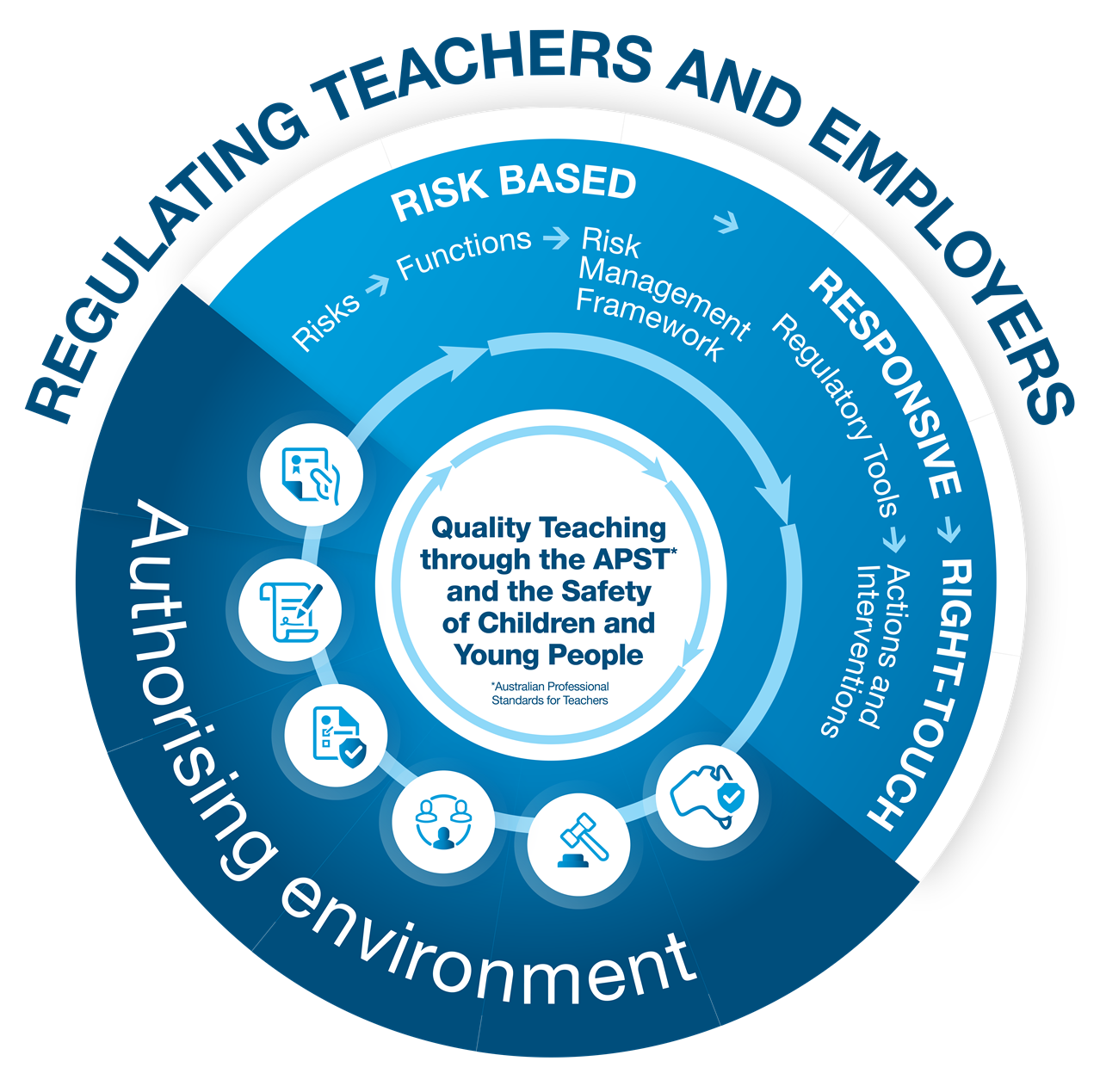
We regulate in a way that is:
- Risk based – We focus our attention where the risk to children, teacher quality or public confidence is highest. Low risk matters are dealt with in simpler ways.
- Responsive – We do not take a one size fits all approach. We choose actions that respond to the specific issue, evidence and level of risk in each situation.
- Right touch – We aim to achieve the right balance between oversight and trust. We intervene only as much as needed and use education and support wherever possible.
Together, these principles promote self-regulation, maintain public trust, and strengthen teacher quality and child safety across ACT schools and early childhood settings.
Working together
The framework reflects our commitment to working collaboratively with teachers, employers, education providers, unions and the community. By working together, we promote:
- quality teaching
- child safety and wellbeing
- professional trust and accountability
- strong public confidence in the ACT teaching profession.
Our regulatory approach recognises that most teachers are self-regulating professionals who meet their obligations consistently and with integrity.
TQI uses nine regulatory tools, individually or in combination, to manage risk and support compliance:
- Eligibility assessment
Teachers must:
- have the required qualifications
- be proficient in English
- move from provisional to full registration
- do ongoing professional learning and development
- adhere to the Teacher Standards and TQI Code of Professional Practice and Conduct (the code)
- maintain WWVP clearance
- Legislative breach management
Employers must report breaches of the Act and the code to us.
We take appropriate and proportionate action against anyone who fails to follow the code or uphold the Teacher Standards. - Evidence based decision making
We analyse data to identify risk and potential focus areas.
We capture and use data to decide if teachers failing to adhere to registration requirements and employer obligations need targeted education, communication or enforcement. - Accreditation of teacher education programs
We are responsible for accrediting education programs for pre-service teachers and teachers in the ACT. Our accreditation process is standards based, future focused, collaborative and relevant.
Providers must show the impact of their program and ongoing program improvement and quality assurance. - Recognition and certification (HALT)
We recognise quality, standards-based teaching during a teacher’s career. This includes a nationally recognised career pathway based on evidence of practice against the Teacher Standards. We certify Highly Accomplished and Lead Teachers (HALT) in the ACT. We build standards expertise across the ACT by training certification assessors and supporting applicants.
- Professional Learning Framework
We encourage and recognise ongoing reflective practices that enhance the status and professionalism of teaching.
This is supported by a legislated requirement to renew registration each year. - Regulatory Framework and Risk Management Framework
These frameworks are the foundation of our risk-based, responsive and right-touch approach to regulation. We use them to assess risk and design regulatory actions and interventions.
- Information gathering and sharing
We gather the information we need to adequately assess risk and decide regulatory outcomes.
We share information with other statutory organisations, registering authorities and employers. - Strategic engagement about risk
Proactive and targeted stakeholder engagement, communication, collaboration and education help us understand and mitigate risk.
These tools allow us to tailor responses from supportive education and guidance through to more formal interventions when necessary